2012 Castle Rock, Cuvée Pinot Noir, CA (cellared and bottled in St. Helena)
I am always scared to taste a Pinot Noir under $10. Why? Because a good Pinot under $10 cannot be done. Can-not! No way. No. Not ever. Never. Well you know what they say about saying never. Never.
Wincing, I opened the bottle. My victim that day was a local chef and presumably someone who would unfriend me for exposing him to this swill. I prefaced my tasting with apologies and gratitude for his bravery. We uncorked, poured and the rest is surprising. We are still friends.
It smelled like a Pinot to me, fresh, light, young, with notes of cherry and hibicus. First sip was peppery, baking spices, dark fruit, currant, medium bodied and very mild tannins with a pleasant woody finish. Very drinkable. Wow, what a delight. I have yet to meet a Pinot for this price point that I could take home to momma – this passed the sniff & sip test…with flying colors.
Who is Castle Rock? I like to research the makers of these fine wines of “Cheapeaux” and often you find a barrel load of corporate drivel laced with fabrications about growers, makers and wineries you will never visit because they in a warehouse in Commerce, California. Ok, I am verging on snobby which is not my style, but let’s keep it 100. How is it possible for these wines to be priced so freakin cheap? Yes, we have all heard the machinations about Two Buck Chuck consisting of high percentages of gopher guts and pesticides (my friends at Trader Joe’s HQ vehemently deny these rumors and I believe them.) But when a wine is actually good and as guest worthy as this one, I’d like to understand how they pulled it off. I mean, bravo, they actually made a ridiculously cheap bottle of wine truly enjoyable.
Moreover, Castle Rock wines are widely available. I believe this one was acquired at a Safeway. So after poking around, I discovered they offer wines from Napa/Sonoma in California, Willamette Valley, Oregon, and Columbia Valley, Washington but they are HQ in Rancho Palos Verdes in Southern California. What exactly does “bottled and cellared in St. Helena” mean anyways? The plot thickens. Go to the source – their website. Ah-ha – this is how they do it.
Well, I like a straight shooter, especially when it’s about what’s going in my Riedels. Moreover, their wines have won several awards of distinction, this 2012 Pinot Noir was awarded a double gold medal and 92 pts from the SF Chronicle Wine Competition. Oh-la-la! Pas mal.
Adding further confidence, their wine makers/growers are both very established and respected in Washington and California. Greg Powers was recognized as a “Rising Star” by Wine Spectator and as one of the “50 Great U.S. Cabernet Producers” by Wine Enthusiast. He started his esteemed career very young by helping his father plant 80 acres of grapes on the family vineyard, Badger Mountain in the Columbia Valley which under his supervision, transitioned the farming from conventional to organic. The California grower and maker, Vic Roberts, is the owner and winemaker at Victor Hugo Vineyards and Winery in the heart of California’s Paso Robles wine country. In 1985 he pursued his dream of being a wine maker by planting 15 acres of grapes on his property which now stands at 78 acres, with the winery located in a picturesque, recently renovated 100 year old barn.
I believe the care and expertise that is put into these widely distributed value wines is fascinating and obviously yields impressive results. This is the dawning of the era of good cheap wine in the US. With producers like Castle Rock, I look forward to trying more….although I cannot guarantee I won’t wince before the first sip.
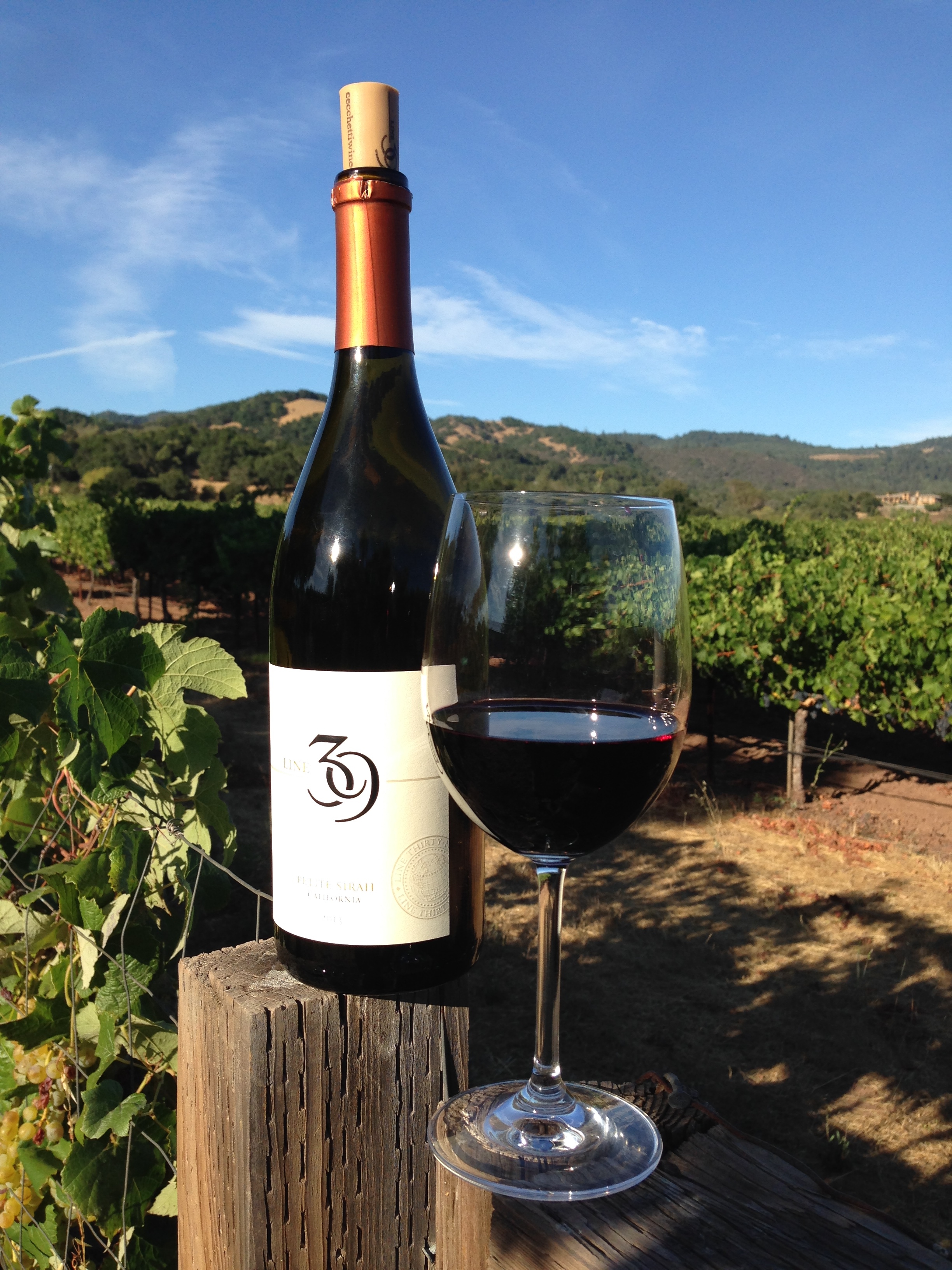
Line 39 2013 Petit Sirah California $9.99
Available at WholeFoods
It was my night to cook, so I was planning on al fresco dining with a menu consisting of an appetizer of cheese, main course of cheese, and a dessert of cheese. The perfect accompaniment would be a full bodied red and a crusty baguette. Bon appetit! Although this meal may not seem well rounded, I think displays of culinary acumen are highly overrated and should be supplanted by consumption and enjoyment. After drinking a green juice, eating a dry chicken breast and doing 50 burpees, I was ready for a heaping serving of self gratification. (I embellished my penance – I actually drank a green juice while spying on a crow rummage through my neighbor’s trash, that’s cheese worthy right?)
The cheese department at my neighborhood WholeFoods is conveniently adjacent to the wine department, wow, how ingenious. I selected three cow’s milk cheeses. First course was a mild nutty Gouda, next a strong, sharp English Seaside Cheddar, and finished the meal with a Dolcelatte (fattier cousin of Grogonzola, if you can believe that.) I pivoted 5 feet to the wine aisle and searched for a bold red to meet the challenge. Looking at the bottom shelf, the hang tags screaming “sale” caught my eye and I found a Petit Sirah for a deal – $8.99 which was a buck off retail of $9.99. Score!
Petit Sirah is actually the Durif variety of red wine grape. It is called “Petit Sirah” because the fruit is recognizably smaller and it is a hybrid of Syrah pollen germinating a Peloursin plant. It’s a full bodied grape that is often used as a blending partner to strengthen other wines.
Once home, I opened the bottle to let it breathe. My expectations were not high as I know all too well the dangers of this job. Once poured, I was optimistic as the nose was immediately a delightful plummy spice, very aromatic. First sip, was very jammy, full bodied, dark cherries, ripe plum, balanced tannins not much acid and a satisfying finish. By golly, this wine is thoroughly enjoyable. Perfect to drink right now with rich Italian foods, pasta, tomato sauce, BBQ and my triumvirate of cheese. It tamed the richness of the Dolcelatte and gave the simplicity of the Gouda a kick. I believe the best accompaniment was the English cheddar, where the sharp saltiness was perfectly match with the fruit of the wine. Add that crunch from the baguette – heaven!
This wine is highly quaffable, a great price and widely available through Whole Foods in the US. It’s not a wine for a sophisticated palate to perseverate over the complexities but that’s not always the point either. It’s very fruit forward, ripe berries with a jammy boldness that pairs best with stronger flavors. Would be the perfect companion to a prime rib, or an Alfredo cream sauce but not a delicate terrine. It’s definitely guest worthy and nearly case worthy!
Another upside to this wine is the label. It is as tasteful as the wine and has an interesting story about the origin of the name which is derived from the 39th parallel that runs through the wine country of California. This is a great bottle to bring as a guest to dinner. No cutesy name and anthropomorphic mascots, just a clever story behind the wine to make it memorable. The host and other guests will have no idea you spend 1/3 of what they thought you did, how generous of you!
This is a guest post on Blogdramedy that recounts my personal dance with the Napa Valley fault line on Saturday night. I threw in some wine editorial – ahem – I mean education for this non-wino audience who will be wowing you with their intel at the next picnic, party, blind tasting or harvest festival any second now.
This quake was the scariest I’ve experienced and we are all grateful as the casualties could have been far worse. Although the town will need years of rebuilding and retrofitting, I wish Napatonians a speedy recovery both physically and mentally as we are now into harvest and ready to put another amazing vintage on the racks.
Apologies of the unappetizing drip – a result of passing the tipple – I promise prettier vines next time.
2012 Grifone Primitivo, Puglia, Italy, from old growth Zinfandel $3.99
Trader Joe’s
Wowza! Just when everyone was losing faith in my crusade to uncover the best wines under $10 – Eureka! I think we struck gold.
My checkered past…
Let’s go in the way-back-machine to about 30 days ago….I was hitting rock bottom, I could not respectably review the wines I was tasting, those bottles will remain nameless but for all intents and purposes, let’s refer to those wines as shite.
A prior post recounted the events that led to the Tepranillo-Gate scandal. I was nearly impeached from cheap wine forever and I believe there were dark forces at work against me. There was a conspiracy behind that unfortunate event, alas alack, there is no point troweling through the past when the future is before us. In this instance, a cheap and cheerful Primativo.
Primitivo or Zinfandel: are they cousins, siblings, identical twins?
Primitivo is a descendant of the rare Croatian varietal Crljenak (pronounce that!) There is plenty of discussion about the differences and similarities of Primitivo and Zinfandel. The latter is often defined as the exact replica of the Crlienak while Primitivo is defined as being a clone. The difference? I’ll have to get into that in another post but you can do a deeper dive here. Read the debates online and decide for yourself, but when planted next to each other the variance is noticeable in size, bunch density and color. What’s the big deal? About $10-$20 in price. Primitivo is sold typically at a value between $10-$15 while Zins can be twice as much. Unlike Europe, U.S. labeling laws don’t allow the names of the two varietals to be used interchangeably. Hmmmm. Market forces at work.
Well I notice a difference and maybe it’s wine stye, but the Puglian Primitivos, although intense in flavor, seem lighter in body, more refreshing (a touch chilled with a wedge of juicy orange – Mwah!) with a pleasant Italian bitterness in the finish that lends itself to the grape’s unique complexity. Zinfandels are jammier, fruit forward and I find them heartier, more body, tastes like California sunshine with a coastal breeze to me. This variance could be due to the propensity for Primitivos to ripen earlier (hence the name which means “early one”) which produces a younger tasting wine high in alcohol and tannins, which can mellow with age.
Without further adieu, I proudly present my latest discovery of undeniable significance…ecco qui:
2012 Grifone Primitivo, Puglia Italy $3.99
This wine was rather delightful. Color in the glass is rich garnet like pomegranate juice. Nose is dark cherry, some light spice. First sip, mmmmmm, juicy rhubarb, rose petal, very smooth, rich, strong yet balanced tannins and a finish that departs as soon as you want another sip. Very enjoyable and also flexible for various food pairings. Will go great with stronger flavors like BBQ, venison and will complement richer fattier delights like foie gras or a densely marbled Kobe. If you were pairing wines for 4 courses, this would be best served with the main course. I actually believe this is caseworthy as it will only get better with time. Dude! Do the math, only $48.00 a case? That’s the price of ONE splurgy bottle of Zin…OMG! No me digas! Sacré bleu! Exclamation exclamation.
Upon my second foray in this friendly competition, I have experienced a wine blogger community that is a knowledgeable and encouraging group of bon vivants. I have been fortunate to personally engage with several influential and talented wine writers and I am grateful for the acquaintance. I see the camaraderie and overall good will amongst these colleagues and I hope one day to be friends with all of them. Kudos to @Dracaenawines for last month’s well earned win and for providing a great theme for this month’s challenge – a theme that describes a virtue they have afforded me – friendship!
Nothing is more heartfelt than a friendship that endures through the highs and lows of life. May sound trite, but it is truly when you know who is really a friend. Prior to this challenge, I became intrigued by a historic friendship that embodies this principle. This is a friendship of legend that is rooted in rebellion, revelry, wine and phylloxera.
I came across this story (the research was inspired by @Fiery01Red review of Wolfersheim’s Wisconsin wine) while thumbing through a tourist guide on the history of Sonoma, CA at a local bookstore – remember those places? During my perusal, I learned more about the friendship between General Mariano Vallejo, one of the founding fathers of California and Count Agoston Haraszthy, the father of California Viticulture (many scholars have challenged this claim but let’s go with the romance of the Haraszthy legend.) Although not much is written about this friendship other than the eventual melding of the families, I can only imagine as neighbors, land owners, pioneers, and winemakers these two men shared many interests in business, leisure and grooming.
Both men where charismatic, courageous, and enterprising. If I had to contrast the noble Gen. Vallejo and the flamboyant Count Haraszthy you could characterize the General as a leader in every sense of the word and the Count as a visionary dreamer. Although both were powerful brilliant men, the contrast in their personas was stark. In a modern context you could compare them to the famous duos Ethel and Lucy, Mick and Keith, Dr. Dre and Snoop Dogg, Miles & Jack and so on…I have yet to find the perfect example, but you get my point. One pragmatic, the other audacious, both equally irrepressible.
Gen. Vallejo was born and raised in California. The son of a Mexican army sergeant assigned to the presidio in Monterey, Vallejo was destined to follow his father’s military career. After completing an education provided by an English merchant who tutored and employed him, Vallejo was well educated and immediately recognized as a born leader. He rose through the ranks quickly becoming the Commandant General of Mexican California by the age of 29. Vallejo and his brother Salvador, an accomplished field officer, served together successfully in several campaigns against the indian tribes of Alta California. Mariano was a skillful military strategist and although he fought against the indians he was also able to engender trust with tribal leaders. His ability to build alliances with the indians proved successful in the constant fight against other waring tribes, illegal immigrants from the US and Russian colonists. Together they secured the territory for Mexico and were generously rewarded by the Mexican government. Thousands of acres in Sonoma and Napa were given to the brothers to farm and ranch.
Vallejo’s Estate Lachryma Montis – “mountain tear” in Latin – is at the base of a hillside near an abundant stream. It still stands today as a CA state park.
Estrangement from the Federal Government of Mexico and the growing presence of US interests with the gold rush, Vallejo recognized the benefits of alignment with the United States. Vallejo used his political graces to persuade other wealthy Californios, ranchers, farmers and land holders of Mexican nationality, to support the US annexation. In June 1846, a month after the start of the Mexican-American war, US settlers in Sonoma concerned about the threat of deportation, captured General Vallejo in what is known as the Bear Flag Revolt. Vallejo was by this time sympathetic to the cause. He was a successful rancher and land owner, selling hundreds of acres to the very people who were in revolt. When the posse knocked on the door of the General’s Casa Grande, he invited the leaders in to discuss the confrontation. As hours passed, the circling crowd became concerned, only to find that Vallejo had opened his wine cellar to the rebels to help facilitate “negotiations.” Sadly, Vallejo was imprisoned but not for long as the US forces acknowledged his allegiance to the US and his role in a successful resolution to the Mexican-American war.
In addition to his other holdings, Vallejo had a vineyard that produced enough wine and grapes to amount to an annual income of $20,000. Many of his grapes were from the root stock of the padres who founded the missions in California wherein they planted “mission” grapes to make wine for their sacrament. These same vines provided the first cuttings to start the Napa vineyards of George Yount, who Vallejo employed as a carpenter.
In 1840, Angoston Haraszthy [AG-goo-stawn HAH-rahs-th’ee] came to the United States and was the first person of Hungarian descent to settle in the US. A flamboyant character who came from European nobility, references to him would vacillate between Count or Colonel Haraszthy. I suspect his title was a matter of convenience – when out East, an air of European aristocracy was to his benefit but when out West, the pioneers took more kindly to someone of military rank vs. class ascension. Regardless, America was the land of opportunity and this fueled the Count/Colonel’s enterprising ambitions. His accomplishments were quite industrious. Upon coming to the new world, he first landed in Wisconsin where he planted a vineyard that is still in existence today called Wollersheim Winery. He also owned and operated a passenger steam boat that traversed the Mississippi.
Health issues and word of the gold rush drove Haraszthy and his family to leave Wisconsin and set out for California. Most Western pioneers dreamt of gold, Haraszthy dreamt of establishing a vineyard and benefitting from the surrounding economic boom. He and his family settled in San Diego where he planted fruit orchards, operated a livery stable, a stagecoach line, opened a butcher shop, organized a syndicate to subdivide a large section of the San Diego Bay shore into streets, parks, and building lots, imported grape vines by mail, planted a vineyard, was elected sheriff, served as city marshal and as a private contractor, he built a jail for the city of San Diego, which was completed in 1851 – but not with out controversy over the jail’s effectiveness to contain its inmates (for a juicy tid-bit click here.)
Upon being elected to the California State Assembly as a representative of San Diego, Haraszthy was drawn to the San Francisco Bay Area. He purchased land and tried to plant grapes on the peninsula, but it was too foggy and the crops were unsuccessful. While representing San Diego in the state legislature in 1852, he met General Vallejo who was a state senator. Vallejo invited Haraszthy to visit him in Sonoma and with that, the legendary friendship began. In 1856 Haraszthy purchased property from Vallejo’s brother Salvador in Sonoma and named the land Buena Vista (The Buena Vista Winery and the Bartholomew Park Winery have beautifully preserved this land and continued to produce fine wines.) Upon arrival to Sonoma, Agoston and General Vallejo soon became very good friends. They were both brilliant, accomplished men passionate about family and wine. They had a friendly competition and both won awards for their wines in the agricultural fairs of the time.
Not only did these two men get on famously, so did their children. On June 1st in 1863, Attilla Haraszthy, 28, and Natalia Vallejo, 25, as well as Arpad Haraszthy, 23 and Jovita Vallejo, 19 were married in a double wedding. (Buena Vista Winery recreated the event upon the 150th wedding anniversary and @CulinaryGadbout was an attendee. Click here to read her account of it)
Haraszthy, always enterprising, soon became acquainted with a group of Hungarian metallurgist lured by the gold rush. Together they started the Eureka Gold and Silver Refinery. He was soon the first California assayer for a branch of the US Mint in San Francisco. All was going well until $150,000 of gold went missing and between 1857 and 1861 Haraszthy battled a criminal and civil case that he was ultimately exonerated of all charges as they were able to prove that shrinkage occurs during the refining process – the missing gold had gone up in smoke.
I’m certain Haraszthy sought peace in the vineyards from the issues that plagued him. I can imagine that the kindly and wise Vallejo was a good friend, confidant and drinking buddy. Throughout this ordeal, Haraszthy was able to start the Buena Vista Vinicultural Society and focus on building a stone winery with cave cellars like the ones he knew well in Europe. Built mostly by Chinese laborers, the cave cellars were carved into the hillside and the surrounding buildings built with the stones that were quarried. (Sadly the Chinese didn’t stick around to contribute to the Asian cuisine of the immediate area.) He hired Charles Krug to be his winemaker and voila, the start of the California wine industry! The facility he built can still be visited today at the Buena Vista Winery in Sonoma. At the time, it was proclaimed to be the largest commercial winery in the US.
In 1858 Haraszthy wrote the “Report on Grapes and Wine of California,” which is considered the first treatise on traditional European winemaking practices in the United States. In 1861 Haraszthy was appointed by the California Governor to be a commissioner on the agricultural advancements of grape growing. Under this charge, he decided to make a fateful trip to Europe to investigate the best European vine-planting and winemaking practices. He traveled through France, Germany, Switzerland, and Spain and upon his return in December 1861, Haraszthy had more than 100,000 cuttings of over 350 different varieties of vines.
Haraszthy intentions to sell the cuttings to the state were dashed when the state refused to purchase them. He was left with the cuttings and all the expenses that were incurred. What to do? He started to distribute the cutting throughout the Sonoma and Napa Valleys. He promoted and implemented the agricultural practice of layering wherein an existing vine develops root stock from one of it’s attached branches. It allows faster propagation of new vines but can leave a crop more vulnerable to infection.
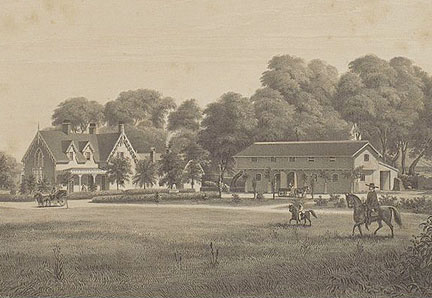
Haraszthy’s home on his property Buena Vista was inspired by the villas of Pompeii. Although the original home is gone, you can visit a stunning replica on the Bartholomew Park Winery grounds.
Haraszthy’s management of the Buena Vista Vinicultural Society was both visionary and cavalier. He borrowed heavily against the property to continue it’s expansion. Shareholders were critical about his business practices. There was a scandal about the misappropriation of funds and the importation of molasses to make brandy. As controversy again swirled, he was able to keep the plates spinning in the air until phylloxera hit.
Mid 1860’s, the vines at Buena Vista were growing brown. Haraszthy’s critics believed this was due to layering, but in fact it was the first infestation of phylloxera ever known in California. This nasty root louse was non-existent before making an appearance in Sonoma. In subsequent years, phylloxera nearly destroyed all the vineyards in California. It even crossed the Atlantic to Europe, where it also devastated crops in France.
Various indiscretions, misfortune and now infestation of his vines led to intense struggles for Haraszthy that continued until he had to claim bankruptcy and was forced from his beloved Buena Vista. His son Arpad remained in the industry and continued to grow grapes, but soon his entire crop but one surviving vine was gone as well.
Another controversy, another frontier. Seeking to rebuild his fortunes, Haraszthy went to Nicaragua in 1868 to plant sugar cane and make rum. On July 6, 1869 it is suspected that while crossing a crocodile-infested river via a tree used as a bridge, he slipped and fell into the water, and as the legend concludes, he was consumed by a crocodile.
Harasthy’s body was never found. The only record is a letter from his daughter who wrote, “We must conclude that Father tried to cross the river by the tree and that losing his balance he fell grasping the limb and then the alligator must have drawn him forever down.”
Vallejo, died in his 80’s peacefully on his estate, Lachmyra Montis, in Sonoma with his family around him. He too faced some serious financial set-backs leaving his finances a pittance to the wealth he enjoyed throughout his life. But I believe a life well loved is a life well led and by all accounts these two friends, through their conquests and failings, made the most significant US contributions to the wine culture we enjoy today.
A very adoring scene of a beloved father, his daughters and a good natured poodle
March 2007, the Culinary Institute of America inducted Angoston Haraszthy into the Vintners Hall of Fame. Seventy wine journalists cast ballots honoring him for his contribution to the development of the California wine industry. The award was accepted with honor by his great-great grandson, Vallejo Haraszthy.
Stay curious!
For more reading pleasure I must credit and provide links to the following sources:
First a disclaimer: I do not work for Ramsgate – I just love their wines and their winery is my dream home – the great hall, the view, long driveway, fire place-es, garden, beehives et all! Designed by award winning architect Howard Backen, it is a modern interpretation of the weathered farmsteads of old Carneros. Very chic – I especially love the wine library. Swoon.
I also enjoy their quick and easy posts on wine education – nothing fancy – nothing to heavy to contemplate, meditate, consternate because they nicely abbreviate. Please enjoy this post on the 7 ways vines are like people. Take special note of point #6. It leaves room for reader interpretation.
“6. They [people+vines] need to be pruned each year in order to grow the next.”
How do people get pruned? Is that like getting your hair and nails done? Man-scaping for the gents? Or is it what happens when sitting in the tub too long? Well, I will not ruminate too much or I might be considered a prune. Maybe this was one of those inside jokes…and my mind wanders….
I was most inspired by point #7:
“7. The more struggles they [people+vines] are forced to overcome, the healthier they – and their fruits – become.”
I agree wholeheartedly with this point. I reflect fondly on past challenges in life that seemed insurmountable and by overcoming them, like a vine, I experienced growth and built character. Coincidentally, my young “fruits” are wine-ing in the face of adversity right now. This mother of a “vine” will not be indulging them with Dum-Dum lollipops and iPad video games for breakfast. They shall become healthier fruit because of it…now go eat your oatmeal and read a book.
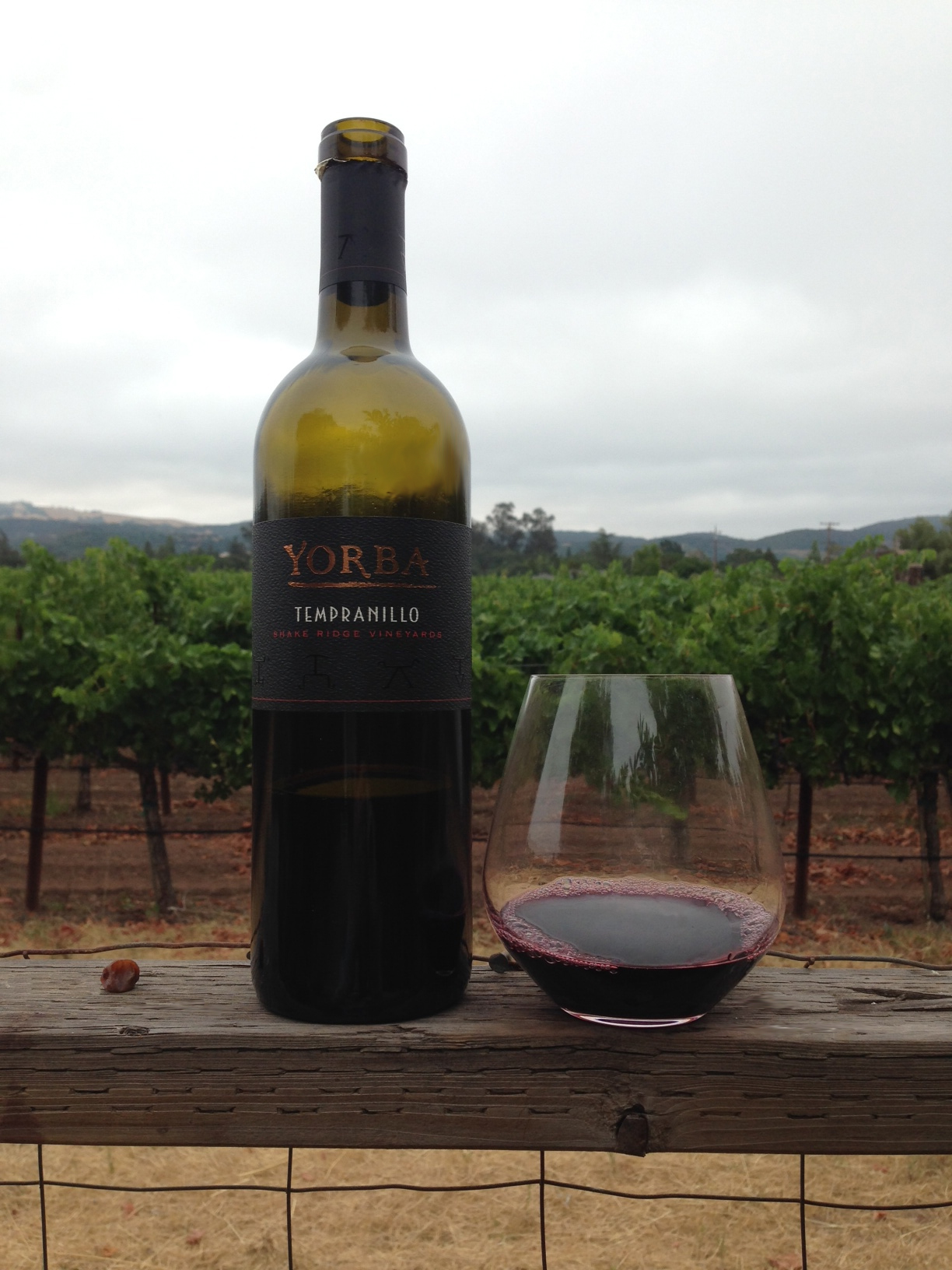
As we were drinking this Tempranillo from from Amador County, I was intrigued to know more about the region. This was the county in CA that was tragically impacted by recent fires. Luckily, no vineyards lost their crops. However, there is concern over “smoke taint” which can produce off putting flavors in the wine especially during verasion. Sadly the fire and the grape maturity were in sync. At best, the smoke can create a campfire essence. We shall see.
Amador County has two sub appellations, Shenandoah Valley and Fiddletown. They are gaining renown for their rich full bodied reds and particularly for Zinfandels. When looking at the 2013 SF Chronicle winners, an Amador County Tempranillo took double gold and I noticed that both the Sierra Foothills and Amador County (neighbors in CA gold country) were well represented Tempranillo award winners. I’m not surprised as rich, bold reds do well in the heat, ample sun, dry climate and sandy soil of the Sierra Foothills. The appellation is 1,200 to 2,000 feet in elevation at the base of the Sierra Mountain snow pack, allowing the soil, which is primarily made up of decomposed granite, to retain enough water wherein growers can dry farm – a concept I had no idea existed! More knowledge to be had at this link: Amador Vinters Association
I truly enjoyed this wine and claim it as my new discovery. The color on this Tempranillo was a deep rich red with a lovely ruby outer ring – nose was immediately dark ripe fruit with a hint of raspberry, blackberry – first sip pomegranate, hint of spice, very balanced tannins and acid, smooth, light but with a body that was a pleasant surprise. I’m a Pinot fanatic and this reminded me of a lovely, smooth Pinot, with a touch more fruit. One guest suggested it was in-between a Primitivo and a Zinfandel – ooooh fancy chat – I’ll have to research that one.
Another guest told me that there was now a “chance in hell” that he would consider buying wines under $10 after tasting this wine. I was so smug until I finished writing this post. Upon fact checking the price on winesearcher.com, I realized I had made an oopsie. This wine had accidentally “mixed” with the wrong crowd in the câve. Someone (who shall remain shameless) retrieved it at my request, and I did not notice upon decanting, serving and tasting that this Tempranillo was not the intended Tempranillo. F! I had already written my notes and practically finished this post (which many of you already know is a higher hurdle than tasting wine.) Sheepishly, I have decided to share this review with you because I know you can keep a secret. Between us friends, this wine was very good and well worth $38.00! Shhhhhhh! If you are in the mood to trade-up, or need a hostess gift that will get you invited back, this was a splurgy good buy. I apologize for the unintentional deception, all I can say is the butler did it.
Stay curious!
PS: This happy accident has resulted in an addendum to my rating system. “Splurgy good buy”will now be a new classification when unwittingly necessary.
Walla Walla’s Success as Applied to the Cluster Theory of “Competitive Advantage”
I love to geek out on business data and the wine industry has more than enough reasons to get your geek on. Professor Emeritus Mike Veseth is one of the leading wine industry economist and always presents his work in a reasonably easy way to understand and apply.
In this post he explains some economic theory as applied to the Washington wine industry, specifically Walla Walla. Ok people, especially Francophiles and Californians (notice how I didn’t mention the wine regions less prone to superiority complexes?) We may be fabulous, but we can all learn something from mes amis in the North West. They are taking no prisoners and when cult wine makers like Todd Alexander are lured from Napa to go work in WA – it’s time to take notice. More on that story at this link: http://bit.ly/1oGELAt
My key takeaway: Walla Walla’s success as one of the top performing wine regions in the US has been accelerated through the dynamic and synergistic interaction of wine industry people. The research categorizes them into four loose groups: the Pioneers, the Next Generation, the Foreign Legion and the Millennials. It’s a good read and not much longer than my preamble.
I will admit, I’m not well versed in WA wines, but I will now start taking notice.
Harvard business professor Michael Porter famously conceived of a “cluster” theory of “competitive advantage.” It isn’t one thing that makes a regional industry successful, he said, but rather it involves the dynamic interaction of a network of forces and factors that, when they come together, create an environment where all are successful.
Porter’s “diamond” analysis can be applied to many regions and industries, even wine. In fact. Nick Velluzzi of the Walla Walla Community College has applied it to his region’s wine sector (click here to read about his research). If you are interested in wine clusters or Walla Walla you should check out his work.
I am interested in how and why Walla Walla has risen to the top tier of American wine region, but this week I want to talk in terms of human networks not Porter’s approach, which focuses on networks of market institutions. It seems…
So there I was, tapping away at the keyboard, enjoying my new-found self-appointed career as a food and wine journalist dreaming up idea after idea of posts to like, retweet, memes to create, memes to share, people to poke, chats to follow, inside jokes to make, hashtags to use…you know the typical stuff one does when one doesn’t really want to earn a living. Then startlingly I received one, possibly my first ever, guest comment on my blog from someone at McCue Communications.Mon Dieu!
She wanted me to give her my information so she could send me some wines to try. They were actually going to send me wine? Huh? What’s the catch? Ah ha….so that’s what this is all about. This was a similar epiphany to the day I realized that golf was more about betting money and drinking beer with the “fellas” than it was about golf. I gave up golf too soon to fully partake. Quelle dommage.
Being accustomed to buying and reviewing wines of my own volition, I was concerned about my freedom to express an opinion untethered by wine sent gratis. What do I do if they, ahem, are not so good? Luckily, the Arrogant Frog wines by Domaine Paul Mas made my job much easier and euphemistic free. Moreover, I had the pleasure of tasting with other wine writers I deeply admire including Sir Jeff Siegel winecurmudgeon.com, Michelle Williams rockinredblog.com and Beth Smith travelingwinechick.com – who happens to be my neighbor so we made a lunch date.
The Humble Wine Maker
This frog gets around.
It was a privilege to partake in the virtual tasting with fourth-generation vintner Jean-Claude Mas to learn about his latest value vintages. His family has led premium winemaking in the Languedoc region from their centuries-old estate since 1892 and when M. Mas took the reins in 2000, he dedicated his wine making practices to preserving the land and the beauty of Languedoc. In 10 years, he plans to transition all 8 of his family wineries into organic vineyards that employ natural farming principles through the use of the latest technology. This has already reduced the need for pesticides and other chemical based agricultural practices that can harm the natural balance. “We must preserve the beauty of Languedoc, and feed the Earth with nutrients in the way nature intended. The use of chemicals for the past 50 years has stressed the vines and now we need to use technology to bring us back.” In summary, it is about making old world wines with new world attitude. C’est tout!
Rebellion & Resistance: The history of Languedoc Roussillon, South of France
7 Things that I learned about the Jean-Claude Mas philosophy:
1. He prefers new American Oak to French Oak – definitely a new world attitude.
2. He believes advancements in agricultural technology will replace the need for chemicals – hooray!
3. He believes a vacuum wine stopper is “utter stupidity” – good to know.
4. The Frog on the front of the bottle is the “humble wine maker” – I chose to name him Hubert de Vin-chy.
5. He likes Stelvin screw caps for white wines and cork for red. (pro vs. con see this post on bauduc blog)
6. He believes all his wines taste even better after 24hrs. I agree.
7. His style of wine making is not aggressive but soft due to the ripeness of the grapes in the South of France.
Now on to the wines…
The peaches are nearly ready to be picked, grilled, doused in cream, baked into a rustic tarte, made into ice cream, eaten off the tree – ahhh Summer.
Arrogant Frog 2013 Sauvignon Blanc $10
The first thing I detected in the nose was lemon and grass. First sip is crisp, citrus and bright – reminded me of a New Zealand Sauv Blanc vs. the California Sauv Blancs I enjoy at this price point which can be more fruit forward. I enjoyed this wine and found it had a nice bright mild acidity and a smooth finish that was a touch buttery. It was very enjoyable. For $10 at retail, it would be a challenge to find a wine of this quality for a better price – I’d buy it again. I’m about to harvest my peach trees in a couple of weeks so I think this will pair perfectly with some grilled peaches and a cheese board of aged cheddar, gouda and a Humboldt Fog.
Coq Au Vin recipe anyone?
Arrogant Frog 2013 Pinot Noir $10
The color was dark garnet with a red-brown halo, which was unusual to me. There was a comment made about this being a “refreshing” Pinot Noir. As it was a warm climate Pinot, when slightly chilled, one can appreciate the delicate flavors of cherry and very light oak. Due to the warm climate in Languedoc, the Pinot grapes mature fast, unlike classic Pinots (like on the Sonoma Coast) that mature slowly. M. Mas explained that he takes great care in deciding where these grapes are planted to ensure the best result, although he did admit, this Pinot was unlike most typical Pinots. I found it very unexpected. I let it open up the next day and albeit pleasant, it was not necessarily the right flavor profile for this Pinofile. I would say it was respectably drinkable and it was fantastic the next day for braising chicken with tomatoes and peppers picked from my garden in my Le Crueset for hours and hours and hours – delish! What little wine there was left, did sip nicely with the meal.
Arrogant Frog 2013 Chardonnay $10
The nose was immediately and undeniably pineapple. First sip was lemony with a light oak finish – 25% of this wine was aged in Oak which contributed to the lactic character on the mouth which is the toasty flavor the oak expresses through the wine – some refer to this as creme brûlée. I enjoyed this wine and it was an outstanding value for $10. This Chardonnay was aged in American Oak which was quite intriguing to me. When I asked what the difference was between American and French Oak M. Mas explained that the American oak gives more lactone resulting in more toasty vanilla notes than the French oak which is more subtle. When the oak is very dry, it does not dominate the character of the wine. (Note to self, more wine knowledge to be had in the procurement, aging and use of oak in the wine making process. I found a succinct post on thekitchn.com about French vs. American Oak) In Mediterranean made wines, the American oak is preferred as it lets the wine breathe less and is better when aging very ripe grapes. As M. Mas explains “in Languedoc we can pick the grapes when we want, not when we can. Think about that…” I think this Chardonnay is a delight. An everyday luxury I would buy again.
Arrogant Frog 2013 Cabernet Sauvignon (55%) Merlot (45%) $10
Nose is blackberry, blueberry, dark fruit. First sip is spicy, cocoa, vanilla, coconut and raspberry. Nicely complex and toasty from the US Oak. Soft, round not aggressive and very refined tannins and acidity. This wine is excellent with dessert, especially chocolate! Rich and bold, this wine could easily pass for a $40 bottle of wine. When asked about how the cocoa flavor was achieved, M. Mas answered it was from the ripe fruit and the American Oak. This wine is a buy again. I don’t want this wine, I need it!









 ed about the Jean-Claude Mas philosophy:


 CHEAP WINE CURIOUS